Defender Modular Series
Configurable RF jamming system
The Defender Modular platform uses FPGA-based reactive signal processing across a wide programmable frequency range. Configured per project for counter-UAS operations, telecommunications denial, or any combination within the same system. Frequency bandwidth, power allocation, and antenna layout are defined to the operational requirement. The specifications below describe the systems's full capabilities. Named reference configurations show setups for common mission profiles.
Capabilities
Single Module
Configurable
According to project requirements
- 20 - 500 MHz
- 500 - 2700 MHz
- 2700 - 5000 MHz
- 5000 - 6000 MHz
- 6000 - 8000 MHz
Constants
Shared across all configurations
- Semi-Reactive: 18 μs
- Reactive: 36 μs
Jamming distances are illustrative for C1-class drones per EU frequency and power standards. Actual performance varies with terrain, target power, and antenna configuration.
Antenna
Directional, omnidirectional, or sectorised — configured to the operational requirement
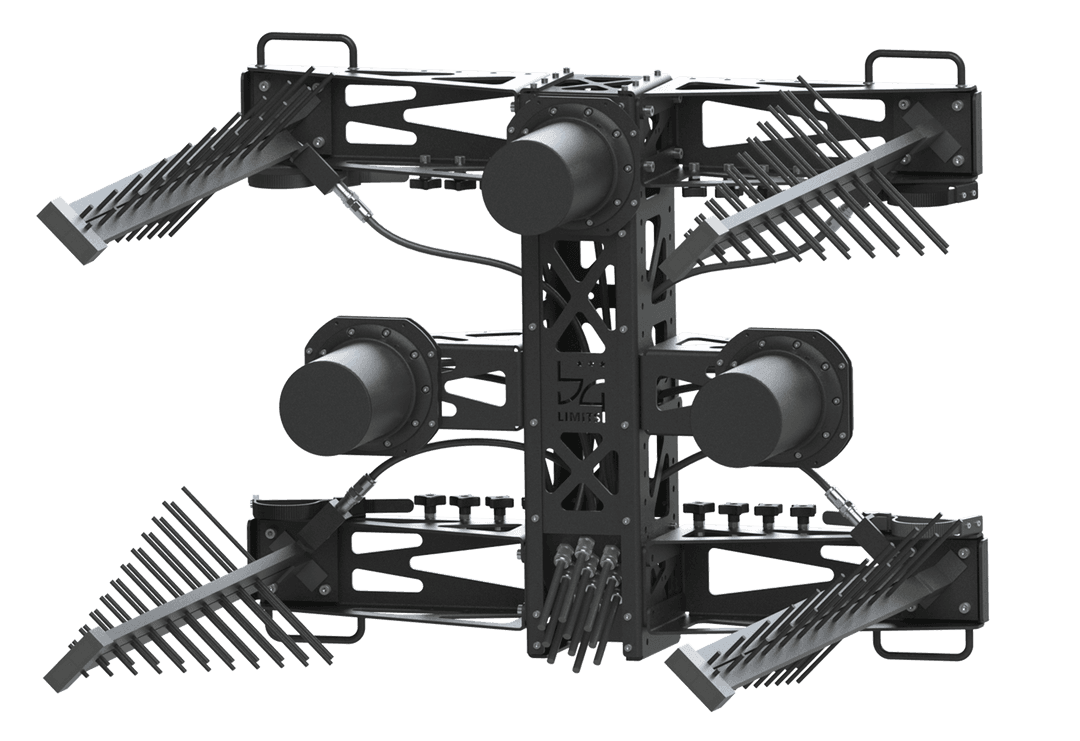
The effectiveness of any jamming system is fundamentally linked to its antenna subsystem. B4 Limits has developed and qualified a dedicated suite of high-performance directional antennas alongside proven omnidirectional solutions, all optimised for integration with the Defender platform.
Directional antennas with 60° azimuth/elevation beamwidth provide increased gain and focused energy delivery, improving effective range against specific threat sectors. Full 360° coverage is achieved through a sectorised architecture using six directional sectors — maintaining high gain across all directions. Omnidirectional antennas offer uniform coverage where simplicity is prioritised, with a trade-off in gain and effective range.
This modular approach allows configuration per operational requirement: fixed-site protection, convoy security, forward operating bases, or rapid deployment scenarios. The antenna subsystem supports both static and mobile configurations.
Defender RF Box
Antenna switching module — change coverage pattern without recabling
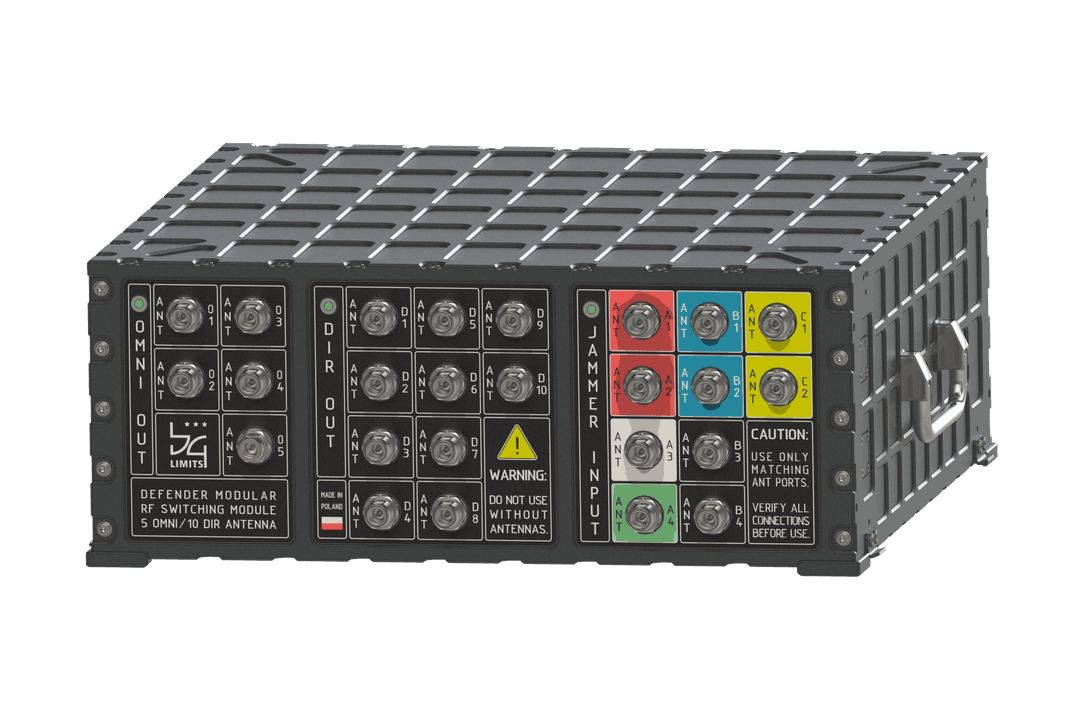
The Defender RF Box is an RF switching module that connects between the jammer and two independent antenna sets. It enables instantaneous low-loss switching between antenna configurations during operation — for example, toggling between directional and omnidirectional sets, or between two directional sets covering different sectors.
Conventional antenna changes require physical disconnection and reconnection, introducing downtime and signal loss. The RF Box eliminates this by routing the RF path electronically, maintaining signal integrity during the switch. This allows operators to adapt coverage pattern to a changing threat environment without interrupting jamming operations.
On request, the system can also provide additional RF signal conditioning functions, including RF path combining and output signal filtering. These features allow optimization of the transmitted spectrum and help prevent interference with unintended or protected RF bands, improving electromagnetic compatibility and operational safety in complex spectrum environments.
Reference configurations
The following are proven configurations. Each can be adapted to specific project requirements. Contact us for a configuration tailored to your operational environment.
WB6600M3G
Custom Counter-UAS — 3 modules (extended RF Power)
Bandwidth Allocation (total 1650 MHz)
Power Allocation (total 660W)
Antenna Configuration
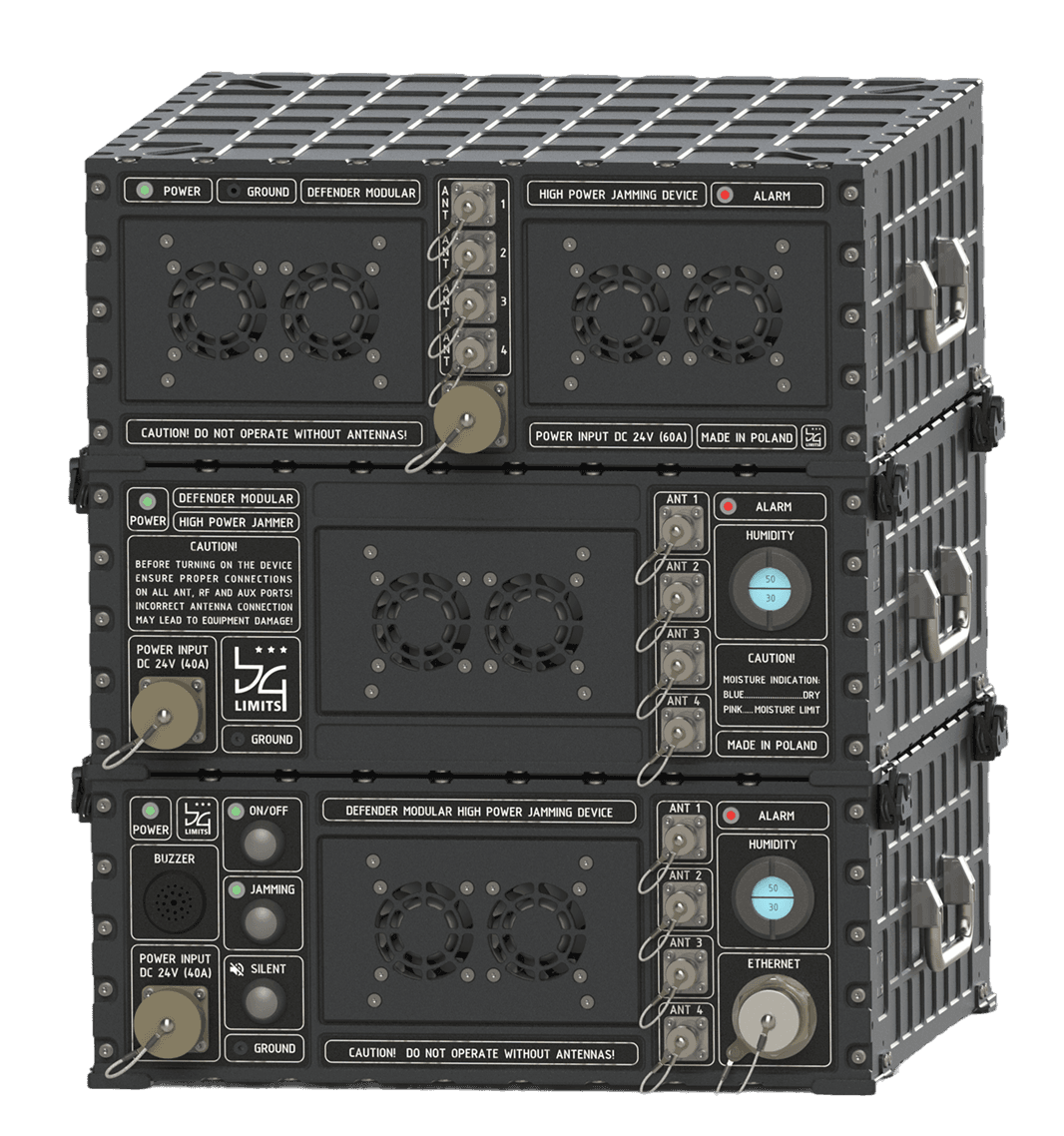
Three-module counter-UAS configuration covering primary drone control, video, telemetry frequencies across 400 - 6000 MHz. Combined 660W output through directional antennas concentrates power toward the threat sector, maximizing effective range against Class 1 FPV and commercial UAVs. All modules operate as a single coordinated system.
Typical use: FOB perimeter defense, convoy protection, critical infrastructure, checkpoint security, vehicle-mounted operations
WB6600M4G
Counter-UAS — 4-module wideband configuration
Bandwidth Allocation (total 2700 MHz)
Power Allocation (total 660W)
Antenna Configuration
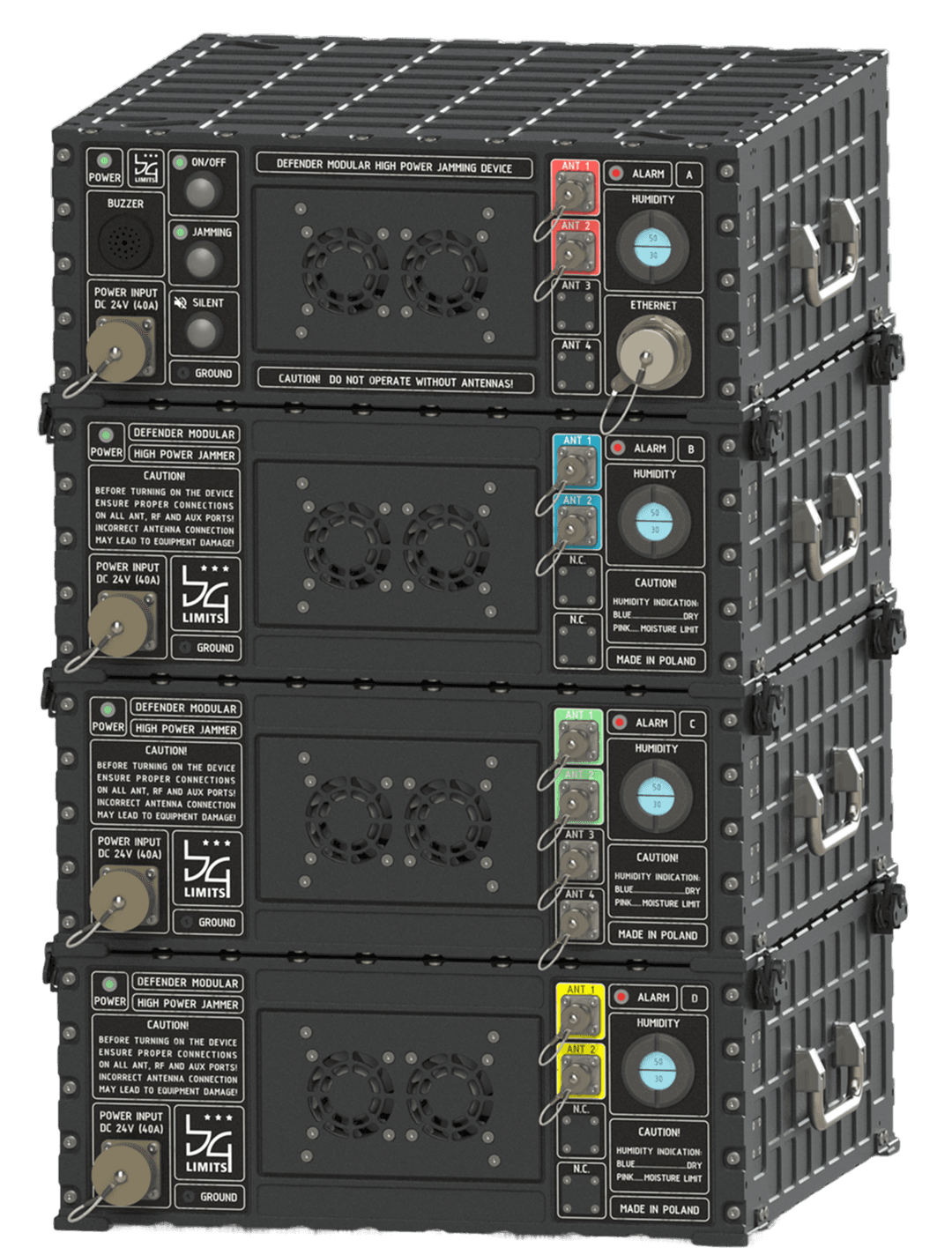
Four-module counter-UAS configuration delivering 2700 MHz of simultaneous bandwidth across 500 - 6000 MHz. Covers primary drone control, video downlink, telemetry, and Wi-Fi frequencies with 660W combined output. Wider simultaneous bandwidth enables engagement of multiple threat protocols concurrently. All modules operate as a single coordinated system.
Typical use: Wide-area perimeter defense, multi-sector coverage, critical infrastructure, large-scale event protection, distributed field deployment
Technology
FPGA-based reactive jamming
Unlike conventional VCO-based jammers that broadcast continuously across all frequencies, Defender uses Field-Programmable Gate Array (FPGA) signal processing to detect threat transmissions and generate precisely targeted jamming within 18 μs. This reactive approach directs all available power to confirmed threat frequencies rather than spreading it across empty spectrum — extending effective jamming range by up to 3x compared to active (continuous) jamming at the same power level.
Three operational modes
Active — continuous broadband jamming across all configured frequencies. Maximum coverage, highest power draw. Use for known, persistent threat environments.
Semi-reactive — detects threats and activates a predefined jamming pattern across the entire configured range within 18 μs. Silent when no threat present. Medium power-to-range ratio.
Reactive — listen-only until threat detected, then targeted jamming of the specific signal within 36 μs. Silent when no threat present. Maximum power-to-range ratio. Ideal for battery-powered or covert deployments.
All three modes can be mixed simultaneously across different frequency channels within the same unit.
Jamming behaviour is defined by software profiles, not fixed firmware. Each profile specifies frequency ranges, power allocation per range, jamming algorithm, and operational mode — configured independently per range. Profiles are encrypted during transfer and decrypted on the jammer, preventing unauthorised configuration. Multiple profiles can be stored on-device and activated by field operators through Leo's simplified interface — enabling rapid adaptation to changing threat environments without returning equipment for reprogramming.
Integration
Defender integrates into existing counter-UAS architectures as the defeat/engage layer via REST API or NATO SAPIENT protocol. Designed to work alongside third-party radar, EO/IR, and RF detection systems within the detect → track → classify → engage kill chain. Multiple Defender units synchronize automatically for coordinated coverage across wide areas. Jamming profiles are encrypted in transit and decrypted on-device, preventing unauthorized configuration changes.
See our system in action
Schedule a live demonstration against live drone targets in real field conditions