Defender Manpack Series
Man-portable configurable jamming system
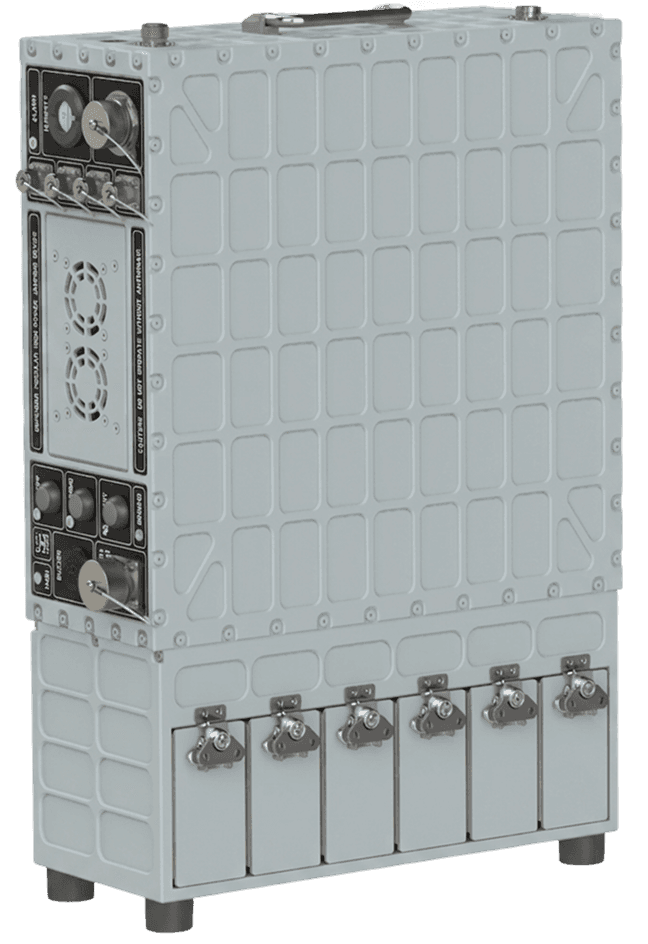
The Defender Manpack is a compact FPGA-based jamming platform weighing ~32 kg in a man-portable form factor. Each unit is configured to the operational requirement — from targeted 5G modern telecom jamming to full-spectrum counter-UAS defeat. The same chassis supports both narrowband precision applications and wideband reactive jamming, with power output scaled from up to 200W depending on the mission profile.
Manpack configurations can operate as standalone systems, synchronize with other Defender units for extended coverage, or serve as the portable complement to a Modular-series fixed installation.
Capabilities
Platform configuration
Configuration
According to project requirements
- 20 - 500 MHz
- 500 - 2700 MHz
- 2700 - 5000 MHz
- 5000 - 6000 MHz
- 6000 - 8000 MHz
Constants
Shared across all configurations
- Semi-Reactive: 18 μs
- Reactive: 36 μs
Jamming distances are illustrative for C1-class drones per EU frequency and power standards. Actual performance varies with terrain, target power, and antenna configuration.
Reference configurations
The following are proven configurations. Each can be adapted to specific project requirements. Contact us for a configuration tailored to your operational environment.
MP2500M1G
Counter-UAS — directional, custom configuration with extended RF power
Bandwidth Allocation (total 900 MHz)
Power Allocation (total 250W)
Custom configuration exceeding standard platform output — available on request
Antenna Configuration
Directional counter-UAS configuration delivering 250W across 400 - 6000 MHz through dual LPDA antennas with 60° beamwidth and ±45° dual polarisation. Three power channels — 100W low-band (400 - 500 MHz), 100W mid-band (700 - 2700 MHz), and 50W high-band (2700 - 6000 MHz) — cover primary drone control, video downlink, telemetry, and Wi-Fi frequencies.
Typical use: Dismounted patrols, checkpoint security, forward observation posts, VIP protection details, directed perimeter defense
Technology
FPGA-based reactive jamming
Unlike conventional VCO-based jammers that broadcast continuously across all frequencies, Defender uses Field-Programmable Gate Array (FPGA) signal processing to detect threat transmissions and generate precisely targeted jamming within 18 μs. This reactive approach directs all available power to confirmed threat frequencies rather than spreading it across empty spectrum — extending effective jamming range by up to 3x compared to active (continuous) jamming at the same power level.
Three operational modes
Active — continuous broadband jamming across all configured frequencies. Maximum coverage, highest power draw. Use for known, persistent threat environments.
Semi-reactive — detects threats and activates a predefined jamming pattern across the entire configured range within 18 μs. Silent when no threat present. Medium power-to-range ratio.
Reactive — listen-only until threat detected, then targeted jamming of the specific signal within 36 μs. Silent when no threat present. Maximum power-to-range ratio. Ideal for battery-powered or covert deployments.
All three modes can be mixed simultaneously across different frequency channels within the same unit.
Jamming behavior is defined by software profiles, not fixed firmware. Each profile specifies frequency ranges, power allocation per range, jamming algorithm, and operational mode — configured independently per range. Profiles are encrypted during transfer and decrypted on the jammer, preventing unauthorized configuration. Multiple profiles can be stored on-device and activated by field operators through Leo's simplified interface — enabling rapid adaptation to changing threat environments without returning equipment for reprogramming.
Integration
Defender integrates into existing counter-UAS architectures as the defeat/engage layer via REST, NATO SAPIENT and TAK protocol. Designed to work alongside third-party radar, EO/IR, and RF detection systems within the detect → track → classify → engage kill chain. Multiple Defender units synchronize automatically for coordinated coverage across wide areas. Jamming profiles are encrypted in transit and decrypted on-device, preventing unauthorized configuration changes.
Frequently asked questions
How long does it run on battery?
Up to 8 hours of continuous operation at full output on custom-engineered batteries optimized for the Defender power profile. In reactive mode, runtime extends further because the system draws peak power only during active engagements.
What's the difference between the Manpack and the Modular series?
Both share the same FPGA-based reactive architecture, 20-8000 MHz coverage, software ecosystem, and integration options. The Manpack is a single self-contained unit for dismounted operations, facility protection, and rapid deployment; the Modular series scales by combining multiple modules into one synchronized system. Both can operate together in a networked deployment.
Can one Manpack cover both counter-UAS and telecom denial?
Yes. Each unit is configured per project — from narrowband precision targeting such as 5G denial to wideband multi-threat counter-UAS coverage — and multiple modes and algorithms can run simultaneously across different frequency ranges within the same unit.
See Defender in the field
Schedule a live demonstration against real drone targets and see reaction time, range and reactive modes in real conditions.